The Child's First Outing
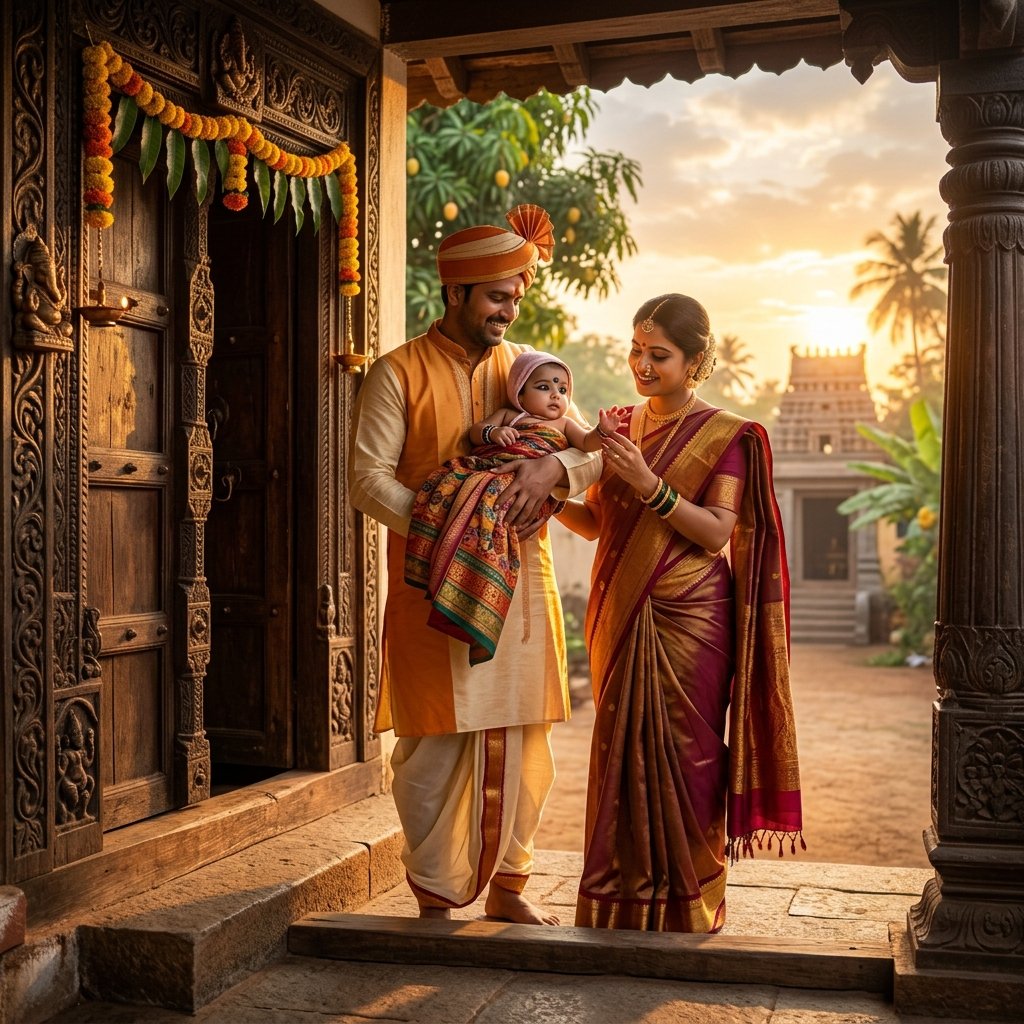
The Nishkramana Sanskar (First Outing Sacrament) is the sixth of the 16 Vedic Sanskars. The word 'Nishkramana' literally means 'stepping out' or 'going forth'. This ritual marks the newborn's very first formal outing from the confinement of the house, where they are introduced to the grand cosmic elements—specifically the Sun (Surya) and the Moon (Chandra).
According to the Grihya Sutras, a child is born in a highly protected, almost entirely sterile, and dimly lit environment. Nishkramana is the conscious, spiritual process of connecting the child’s developing soul and senses to the vast, limitless universe (Prakriti), seeking the blessings of the Pancha Mahabhutas (Five Elements).
The timing is based on the baby's developing physical strength to handle direct sunlight and outdoor air.
The ritual involves a simple Puja before stepping out of the house boundary. The items include:
The baby is bathed and dressed in fresh clothes. The mother hands the baby to the father. The family steps out of the house into an open space or a temple courtyard. The father points the child towards the Sun (Surya) to absorb its life-giving energy, chanting:
"May we see the bright, pure, God-ordained Sun rising in the east. By its grace, may we live for a hundred autumns, seeing clearly for a hundred autumns."
Modern pediatrics aligns perfectly with this timing. By the 3rd or 4th month, a baby's immune system is strong enough to handle outdoor exposure. Furthermore, their vision develops to focus on distant objects, making it the ideal time for visual stimulation via natural sunlight (which aids in Vitamin D synthesis and prevents neonatal jaundice).
A: Traditionally, the baby is taken to a nearby temple, a clean park, or the banks of a sacred river (like the Ganges in Kashi) to receive divine and natural blessings.
A: Yes! Chandra Darshan (viewing the moon) is also highly auspicious, especially if the baby has a sensitive constitution, as the moon represents cooling, nurturing energy.